27 July 2008

The Power of Prayer

OK, it wasn't an AK, but it was damn close...

Lawrence of Arabia with Sheikh Khaled Al-Atoun, give or take a hundred years


Only fired off one round at a time (ammo is very expensive in Jordan), but the pictures are in no short supply.

Obviously only the sheikh, another Bedouin and I hit the target down range. I am not even joking.

Read more...

25 July 2008

Kalashnikov

I type this post from an office in a research center in the city of Ma'an. Two minutes ago someone got married. Do you know how people celebrate weddings in Ma'an?

By emptying the clip of an AK-47.

In two hours time I will be traveling to within 30 km of the Saudi border to spend the night with a sheikh who studied advanced farming techniques in New Mexico. Do you know how this sheikh welcomes visitors to his home?

By emptying the clip of an AK-47.

I asked our academic director about gun ownership among the Bedu.

"You will not find a Bedouin who does not own a gun."

I asked our academic director about the possibility of seeing the sheikh's guns.

"You will see lots of guns tonight and tomorrow."

If you asked me what would make or break my trip to 30 km from the Saudi border to visit with the sheikh, I would answer you with one condition only:

That I empty the clip of an AK-47.

I haven't asked for anyone to pray for me on my travels to Jordan, but I come to you now, my friends with religious leanings and my friends without them, pray that this one simple request is granted for me as my time in Jordan comes to a close.

That I empty the clip of an AK-47.

Insha' Allah.

Read more...

22 July 2008

Back in the Badia

Been travelin' round Jordan for the last five days, mainly in the northwest and in the Badia desert.


Jerash, ancient Roman city of the Decapolis.


Golan Heights & Lake Tiberius / Sea of Galilee


Throw up your six shooters for American imperialism!

The Badia is Jordan's version of West Texas. I'm staying on an ecological restoration and social development project headquarters on a dilapidated air force base used by the Americans to stage bomber runs in the first Gulf War. Think Area 51 minus everything that makes Area 51 so cool (the X-Files, the video game, and the conspiracy theories) and that's been me for the last four days.

I did have the chance to hang with a semi-nomadic Bedouin family one afternoon and talk about the effects of rising fuel prices. For the Bedu, it breaks down into economic and cultural repercussions.

Shepherds and grazers have recently been experiencing negative returns on their flocks; it's costing them more money to raise sheep and goats than they are receiving at the market for them. The culprit? Rising fuel prices increase feed prices, as the accompanying increase in production costs are passed on to the consumer. You would think that they could absorb these costs by increasing the price per head of their animals, but with gas prices driving inflation across the economy on essential goods (for the same reasons feed prices are going up), the quantity demanded for goats and sheep, a luxury good for most people, is on the decline. The Bedouin find themselves caught between local market forces and global economic entanglement as their income decreases and their expenditures increase.

Next, they need water for the herds. Old school Bedouin could graze near natural water sources in the desert or rely on simple rain harvesting techniques. This has been made exceedingly difficult now due to increased water demand from the cities, which leads to over-pumping renewable groundwater sources (and in the case of the Azraq oasis, drying out the natural springs that once fed the wetlands completely); below-average rainfall (blamed on global climate change even out in BFE, where we saw some Al Gore light bulbs); desertification, caused in large part by over-grazing, which leads to increased surface evaporation and soil degradation; and changing hydrological systems due to diversion projects in Jordan, Syria, and Israel. Now, most of the Bedu have to live "on the grid" for water, which often means settling. If they don't settle they can drive into town to buy water (assuming they have a truck) from the government or private sector, but that's also too costly due to rising fuel prices and water scarcity, so it makes less and less sense, and in some cases it's completely unfeasible, to live away from the village and maintain the nomadic ideal.

To deal with these increased hardships, the government "encourages," rather than "pressures" (their words, not mine) the Bedu to settle in simple villages that provide basic social services. In some cases, shepherds and their families who have sold off all their animals live essentially on welfare with no income, as their only source of livelihood and only skill-set has became unsustainable. But method of subsistence isn't the only piece of culture is being eroded. Per customary Bedu hospitality, a sheep is slaughtered and served as a large family-style meal for guests. As you can imagine for the shepherds, that kind hospitality is more and more costly. Even for those who live in larger villages and moderate cities and maintain a sense of Bedouin heritage, buying a sheep for a special occasion or family affair is at the mercy of the increasingly expensive grocery list.

Who did the Bedu we talked to blame? Yep, America and it's control/persuasion (not sure which they meant) of the oil markets.

Regardless of whether oil prices are at their present levels due to speculation, sabre-rattling between Iran and Israel, or peak oil theory, the costs are felt in far more places than just at the American pump.

Read more...

20 July 2008

Read more...

15 July 2008

Conversation roundup

Fresh from the meat locker, some gristle for you to chew on:

  • I met a Jewish Israeli anarchist living on a kibbutz (collective farm) in the southern Arava desert. I quote (in response to the question, 'should Israel exist as a Jewish state?'): "I don't believe in states or their weapons." Did his Ph.D. at Oxford on anarchist politics and now he teaches environmental justice and ethics at the Arava Institute (where I spent last week in Israel).

    For the Bedu to receive social services from the government, they are forced to settle in recognized townships in dangerous proximity to Israel's major environmentally hazardous sites (e.g., Ramat Hovav). Why locate your prison, nuclear power plant, and industrial waste dump near these communities? Several reasons, including: the state's attitude towards Arabs as a "threat to be managed" rather than a partner to cooperate with in promoting ecological and economic sustainability; the Bedu's marginal position in Israeli society, wielding little to no political or economic influence to protest and/or combat corporate or state decisions, demand equal treatment, or hold officials accountable to their actions; and related, as a marginal community (which usually entails a lack of access to social resources including sanitary water, adequate health care, and quality education), the detrimental effects of living near such sites can easily be written off as the Bedouin's "unhealthy lifestyle choices."

    If the Bedu do not settle in government-sanctioned villages, they are ineligible to receive state services, including water and sewage, which obviously creates problems for sanitation and education. This allows the government to claim that it's in the Bedouin's best interest to settle so they can receive the state's blessings ('see, their nomadic culture is so backwards out there in the desert, look how unhealthy they are'). Yet the forced settling is a raw deal as well, as it both undermines traditionally-nomadic Bedu culture (who are used to freely roaming throughout Palestine and the Sinai before the advent of nation-states post WWII) and crams them into artificial villages often in dangerously close proximity to ecological and sociological nightmares. In effect, the state can enact policies with racist undertones -- like plopping these sites in the Bedu's forced backyard -- without individual officials necessarily holding bigoted attitudes themselves (though some obviously do), without the risk of any real political consequence, and without having to accept responsibility for the reason the Bedu don't want to live where they're told in the first place.

    This same sort of government policy and business practice has also been reported in the West Bank; again, politicians and Israeli businessmen have near complete impunity as Palestinians have no say in the Israeli political process. Try pulling this shit in Tel Aviv and your ass goes straight from the Knesset back to pushing papers in a municipal affairs office.

  • Also at the Arava, I met an Israeli girl from somewhere in the north of the country. Growing up she tried her best to isolate herself from the Israel/Palestine conflict, though her parents are leftist activists. Her upbringing eventually caught up with her when she studied at the Arava, and now she's fiercely anti-occupation. Naturally she wanted to know how and why some American boy from Oklahoma? got interested in the conflict when she herself, an Israeli hippie, sidelined it on into her twenties. Somewhere in there we got on the Christian Zionist thing; I think it had something to do with my bitterness for having never been exposed to such a human rights catastrophe in Christian circles and for the rubber stamp Israel always received from those same entities, reinforcing the 'Arab=Bad, Israel=Good' assumption in Palestine while claiming to champion justice elsewhere around the world. She was fascinated, if not slightly dumbfounded, by the whole thing, and hailing from Tulsa I had stories to tell myself. 'Zionism is messed up,' she said, 'but Christian Zionism...that's crazy, man.'

  • A few nights ago I went to a concert with my friend Rasha at Mukhtaraf Remal, an artists' collective that hosts concerts, symposiums, gallery showings, etc., and also has a nice cafe on the roof. Rasha had to bounce early, so I stayed to finish my coffee and enjoy the weather a bit more, when I heard a modest 'excuse me' from the table of three women next to mine.

    'We noticed that you are alone, would you like to join us?'

    Did I just get propositioned by three middle-aged Muslim women?

    They wanted to chat with an American student, being somewhat of a rare commodity around these parts. Turns out they are all Palestinian, have been best friends since college, chain smoke, and are all divorced.

    One of the women, the only one wearing hijab, is from Gaza, the first person I'd met from "hell on earth" (her words, not mine), so obviously we talked about Israel/Palestine and they asked for my opinions and offered me theirs. In particularly, "TuTu" (her nickname) told me that there was no solution; it is too complex, both sides have too much at stake, the Arabs are too weak on their own to muscle the Israelis and the US but the Palestinians have no options but to fight for what rightfully belongs to them. She endorsed a position very similar to the religious perspective outlined by Dr. Weesam in the Badia, that only after the Second Coming and ensuing apocalypse, as told in the Qur'an, would Allah return Palestine to its legitimate owners and expel the Jews. The other two women were a bit less pessimistic and eschatological, one of them (who had lived in the states for some 15-odd years) expressing her desire for the conflict to end no matter how just so Palestinian children could grow up with normal childhoods: reading books, going to parks, playing with real toys.

    I met the women on Sunday night, and since then two of them have called me to see if I needed anything, how I was doing in Amman, and if I'd like to join them at Mukhtaraf again this week. Once again, Jordanians are scoring big points for their hospitality.

Read more...

11 July 2008

Life in the Badia, pt. 3 -- "Muslim, Christian, Brothers."

Farhan's youngest brother, Abu Hasin, had just returned from Mecca (as I've previously mentioned). When we visited his house for tea and coffee my first evening in Umm al-Qatayn, all the talk was about the Haj. The one thing that stuck out in their conversations (in Arabic) was how bizarre it was that there were Shi'ites on the pilgrimage; it's safe to say that Shi'ii Muslims aren't well understood (or acknowledged at all) in certain Islamic circles. Abu Hasin then asked if it was possible for me to become a Muslim.

Of course it's possible.

What I quickly understood (and thankfully, lest I get married off in the desert) was that he had asked me to convert. I declined, saying, with hesitancy, that I was a Christian -- after all, this joker was still in a state of ritual purity (I think). Farhan had asked during our meet'n'greet at his house earlier, but it was asked as a yes-or-no question about which I didn't think too much and about which he didn't ask much more. But, given the questioner in question, who I at the time knew next to nothing about, I wasn't sure how my answer would fly. Miish mushkila, we say in Arabic: no problem. From then on, Farhan was adamant about stressing this simple equation:

Muslim, Christian, brothers.

Farhan (the Muslim) + Muhanid (the Christian) = Brothers.

I asked him several times, 'mushkila?', just to be sure. Farhan sets the cultural tone for his family, religion included, and I didn't want to make a scene by ignorantly proclaiming my Christian faith freely throughout the Muslim village that he is more or less mayor of. Miish mushkila was the only response I ever got.

Muslim, Christian, brothers.

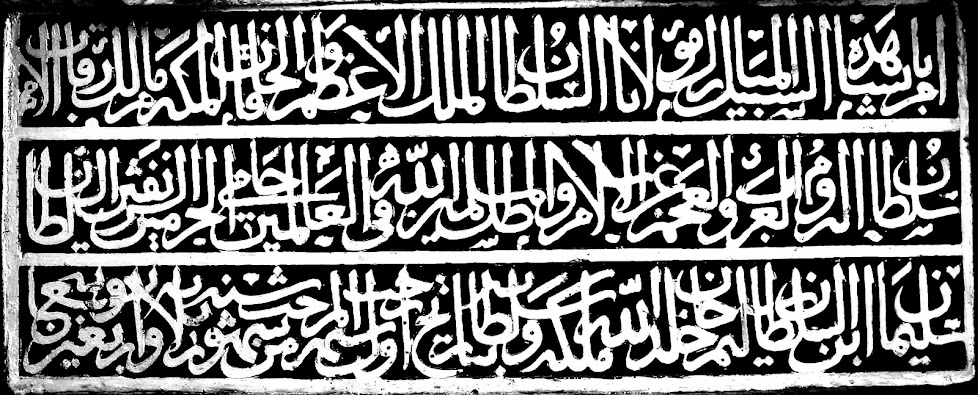
I was given holy water from Mecca, and Farhan taught me to use prayer beads in Arabic. But I lost it when Farhan signed, dated, and gave me his personal copy of the Qur'an. Not just some B-list, Drake Hotel Gideon KJV (those damn Gideons). Beautiful calligraphy adorns the first and last several chapers, plus sections of the Hadith as an appendix, and the font for the regular pages beats any English text I've ever seen.

I’m quite sure that no one will ever really know what I mean when I say that Farhan and his family were the most generous, hospitable, and welcoming people I have ever met. Nothing about life in the States can compare to the way the family treated me not just as a guest, but as their own son.

Farhan was most proud to announce to all his friends that for the weekend he was Abu Muhanid, and I was most proud to be his habibii, sadiiqii, and ibnii.

Read more...

07 July 2008

All the while you thought I was studying Arabic I was actually learning to hate Jews.

Read more...

05 July 2008

Culture shock

Just returned from seeing Hancock at the theater in Amman's largest mall, Mecca Mall. The Middle East weirds me out more and more. It really is impossible to know what the ME is like until you visit; you will never watch enough Al-Jazeera or see enough YouTube clips or read enough books to get it. Stories from friends can't do it justice, nor can photographs of exotic locations or abject poverty.

Amman, particularly the western (direction and imitation), "developing" part of the city, has what appears visually as an enormous identity crises. Within a 10 square foot radius, you will walk by a group of burka-clad women toting Baby Gap-ed out toddlers and brush shoulders with a group of Amman-ian high school girls from an episode of "My Sweet Sixteen" gawking at a college student in H&M attire on his Blackberry checking updates on the Euro Cup with his girlfriend wearing Diesel jeans and hijab. Behind them will be two older men in kuffieyahs and thobs (full body white robe-types) handling prayer beads from Bahrain whose wives are reading People magazine outside of a Starbucks playing Nora Jones and Nickelback. Most of the brands are totally unrecognized, though I have seen a few familiar labels, yet prices are outrageously more expensive here than in the States, on top of the weak dollar-influenced exchange rate.

I would have loved to be alive during the American transition from the Victorian era to the roaring Twenties, because that's about the only thing I can think to compare Amman to today. Fashion designs from the West intended to highlight the female figure are transplanted in a traditionally conservative, religiously-infused society and culture. Media forms in the West who make money by appealing to and exploiting sexual fascination that are wildly popular among even the most "traditional" segments of the population (e.g. soaps in the Badia). Religion really does permeate society here moreso than it does in the States, so reconciling these two seemingly incongruous disjuncts, particularly given what I "know" about Islam, is hard to do as an outsider. It's a society, not unlike its American counterpart, whose participants daily live with what seem to be contradictions and get by nonetheless, all the while with various sources telling them how they ought or ought not to resolve those things for themselves.

It's not that I don't like it here, I very much do. It's just a very different society with very different social fabrics underlying it, and not being from the culture, very difficult to understand, even categorize, the multiplicity of ways that people live their lives.

But I did have a Hardees thick-burger for lunch. Sans bacon, of course.

Read more...

Fourth of July

Last night (in Jordan, that is) was America’s birthday, God bless her. I spent it with an Englishmen, a Thai girl from Saudi Arabia, and an American who’s only lived in the States for about 2 years. Nothing like the glorious stars and stripes that was last summer, when Stray, Seth, and I played 18, grilled bratwurst, shot off some bottlerockets, and capped it with Apocalypse Now Redux. The one thing in common with last year was that I would not surrender my God-given rights as an American to listen to the Boss and CCR on Independence Day.

A group of American students who studied in Amman last semester with SIT and are working here this summer invited the folks in our program to join them for a Fourth bash at their apartment. We met them there for burgers and fruit salad, Tostitos and 10 Stella Artois tallboys (the cheapest beer in Amman, believe it) in tow. The girls that live above them (one American, one English) popped in and said they were headed to a Rammallah Underground concert that evening. Rammallah Underground?! If I’m getting screwed out of Dianna Krall, I met as well replace it with a pro-Palestinian rap bash. The girls had to bake a cake (?) and shower, so Tom (the Englishman) and waited around for them. About 9:30 we started to get antsy, and the rest of my friends from my program had curfews to meet, so Tom and I bounced to the ounce and made our way to the show, planning to meet up with everyone else afterwards.

And of course when we arrived at Books@Cafe, we caught the last thirty seconds of RU’s set. Rap concerts and I obviously do not operate on the same time frame (a la missing Lupe Fiasco, best in the game, opening for Kanye in Dallas). No bother, Tom and I met my housemate Joey at the concert, grabbed some beers and argileh and two hours of A-list conversation. Economics is all about trade-offs, right?

We headed back to the apartment, picking up the gang from a nearby bar. Back at the ranch, the girls who deprived me of Rammallah Underground (but not Bruce Springsteen) had invited more people – non overtly American – to celebrate with: a handful of really drunk Arabs, a few Aussies, a couple of American ex-pats, and a French girl. In prime Jacksonian fashion, I hijacked the playlist for a little Johnny Cash and Billy Bragg + Wilco. We set off fireworks on the roof (only Americans really know how to set off fireworks), drank more Stella, and had the neighbors ask us to quiet down. America!

I’m seriously still a little burned about missing Ramallah last night, but who knows, perhaps I might them or G-Town next Friday in Jerusalem? Oh wait, don't you know that they're playing there THE NIGHT AFTER I LEAVE FOR JORDAN. Good grief.

Read more...

04 July 2008

Life in the Badia, pt. 2 – Palestine, politics, and more reverse-Orientalism

If I could have changed one thing about my stay in the Badia, it would have been that I spoke Arabic fluently. I managed alright with an elementary education, but that also meant that the subject matter of conversations in Arabic stayed at an elementary level. In some ways this was welcome; it allowed certain topics to be handled with a certain innocence and beauty that’s lost when heady theoretics make their way into the conversation (more about that in pt. 3). Two situations in particular necessitated language advanced beyond my capabilities in Arabic, and fortunately during those times, at least one of my interlocutors in the room spoke English.

The first story takes place in the office of an administrative official, Faysal, at the Ministry of the Interior’s Office. As mukhtar, Farhan visits the MoI daily, and though his role in the bureaucratic apparatus of the modern Hashemite Kingdom is mostly symbolic, he does command the respect of a large part of the constituency in Umm al-Qatayn and has significant political influence there. This particular visit saw us in an office with Faysal, his assistant (whose name I regret missing, as he was one of the livelier characters), Farhan, and another villager, though I never figured out whether he worked for the MoI or was just passing the time in the air conditioning.

Faysal spoke a little English, so we started with the basics in Arabic and then switched to broken English when a stalemate hit. How old are you? Are you married? Will you get married in the Badia (really glad I finally figured out what he was asking)? Is it possible for me to marry an American girl that you know? What are you studying? Why Middle East studies? Religious studies too? Sha-na-na-na: reverse-Orientalism comin’ atchya, bitch!

Right on cue, when the conversation dovetailed in that direction, Faysal explained in great lengths that Osama bin Ladin is not only (emphatically) not a Muslim, but that he sure as hell doesn’t speak for Muslims in Jordan, as I would undoubtedly see on my travels throughout the country. I assured him I had already arrived at that conclusion myself, based on my time in Amman, interactions with the people there and in Umm al-Qatayn, and from studying Islam and the ME at the UofA in America.

To test my reverse-Orientalism hypothesis, I asked the group straight up (in Arabic, no less): do all the people in Jordan think that all the people in America think that they are like Osama bin Ladin? The room lit up in affirmation. These men “knew” that all Americans “know” that all Muslims are like OSB. Textbook. I respond that for a large part of the country this is pretty much the case, mainly because most people’s only exposure to inhabitants of the Middle East is through the media and U.S. government statements when there’s some sort of violent crisis; in the U.S. popular imagination, Islam, fanaticism, and bloodshed are intricately linked by the discursive power of “information” outlets (basically, Said’s central thesis in Covering Islam). And therein lies the fantastic counter-power of education –for me, university-level Middle East studies and Arabic classes.

With the government officials successfully pacified, the next day I moved on to a fairly tougher crowd: the intelligentsia of Umm al-Qatayn, doctors at the local medical clinic.

Farahan took me to the clinic to see the healthcare system operating in the village, which, though pretty humble and unable to handle a major catastrophe, does alright for itself by Western standards. There I met a doctor, Abdullah, with whom Farhan is good friends. Abdullah took us to the doctor’s lounge for coffee, tea, and of course cigarettes. Like I said, you better accept that Winston Light, or in this case, that Marlboro Red. There we met a young doctor (30 years old max) from Iraq, Weesam. Straight off the set of Grey’s Anatomy, a Christian (which I didn’t learn until after we’d left) and he spoke English fluently. I would gang with Weesam and his friends any day.

We started with religion, for reasons I can’t remember, and how I’d never felt uncomfortable in the Badia for being a Christian, that the people there were very accepting and welcoming regardless of religious differences. Abdullah mentions that when he was studying medicine in Russia he married a Catholic woman (who converted). Weesam said that the rampant atheism in the West was getting to be a big problem (naturally), to which I agreed, citing my distaste for the militant atheist likes of Dawkins, Harris, and Hitchens, whom he knew all about. I told them I think these cranks are just as narrow-minded and extremist in their views as Osama bin Ladin is in his. As expected, the doctors quickly countered that OSB is not representative of all Muslims (to which I gave the usual response), BUT this time my interlocutors acknowledged the U.S.’s role in arming or supporting today’s Muslim fundamentalist enemies: the mujahideen, Taliban, and OSB; Saddam Hussein against Iran in the eighties; Iran’s clerical regime by our unbridled support for the repressive regime of the Shah. This naturally led the conversation to American foreign policy, particularly proxy wars against the Soviets and how the Cold War mindset and its accompanying ideology of American hegemony influenced (along with the Israeli lobby) the policy makers responsible for regime change in Iraq in 2003. He then asked me about the election; right now I’m for Obama, I said, (provided he doesn’t do anything else stupid like affirming that Jerusalem should be the undivided capital of a Jewish state in pandering to AIPAC), because even so, McCain is entirely too hawkish. Weesam doesn’t really like either of them (naturally), but does think that McCain will win. Not quite sure why. We talked about health care – how all the doctors there aspire to get to America to practice but that it involves passing the US Medical Exam and 10 grand, how the issue is huge in this year’s election, and how Weesam favored Hillary’s plan to Obama’s (naturally).

Naturally, by this point, you should realize that Weesam is probably the most knowledgeable guy I’ve talked to here in Jordan. So, of course, what do I ask him at this point: what do you think a just solution to the Israeli-Palestinian conflict would be?

Weesam began by explaining that there are two ways of looking at the conflict: from a religious perspective and from an Arab perspective. From the former, a position that he did not agree with (whether because he is a Christian or social secularist, I couldn’t tell), the land belongs to the Jews, because, as people of the book in Islam, they had natural rights to the land on the basis of their being there before the Arabs. But, he also added, that some Muslims believe a messianic figure will reclaim the land for the Caliphate, drive out the Jews, and usher in the Apocalypse.

The second perspective, the one with which he sympathized, was that there were Arab people living in Palestine under the Ottomans and on through 1948, were forcibly driven from their homes, and denied their own national self-determination, akin (by his admittance) to the theft, displacement, and massacres committed by the United States against America’s native inhabitants. From this perspective, the Israeli Jews are the aggressors and should leave; Israel should not be viewed as a legitimate, sovereign political entity.

I responded in part agreement – Israel is an aggressive occupying force on land that does not legally belong to it. But that as a humanist (betraying my own religious inklings to the group), I sympathize with the suffering on both sides, Jews in Europe throughout the eighteenth and twentieth centuries and Palestinians living under occupation today. So what did I think a just solution would look like, he asked? I tried my best to explain why I am increasingly convinced by the arguments for a single, bi-national state, particularly given the apartheid situation in the West Bank much like South Africa in the eighties, but that a two-state solution might well be what materializes (if ever). Weesam held fast,that he does not think either of these will work, but that this was only his opinion. I countered that younger generations in the West are more and more sympathetic to the Palestinian cause, that its historic one-sided treatment in the media (again, thanks AIPAC) no longer holds the once-incredibly dominant sway. Even though we didn’t agree on Israel’s right to exist in the end, Weesam consented that he was hopeful that this ‘younger generation,’ myself included, would make aware the Palestinian plight; again, I made note, herein lies the great blessing to pursuing the Middle East studies track, and promised to do my best back in the States.

I wished Weesam all the best, and that insha’ Allah (plus $10,000) he would get to America and practice medicine.

Indeed my new Iraqi friend, insha’ Allah.

Read more...

You've gotta be kidding...

...that despite getting to go to Israel and occupied East Jerusalem next week, I will also be missing Diana Krall (with the fabulous Jeff Hamilton) at the Amman Citadel?! And Algerian night featuring rai artist Khaled?!

Say it ain't so!


Read more...

03 July 2008

Life in the Badia, pt. 1 -- Introduction and stories

Two days ago I returned from living with a Bedouin family in Jordan’s northern Badia desert. I spent four days in Umm al-Qatayn, a village of roughly 12,000 2 km from Syria and the largest Bedouin village in the area.

My homestay father was Farhan Dhadal (Abu Zaid); he is the mukhtar (a Bedouin tribal elder) for his family, the largest in Umm al-Qatayn. He and my mother, Umm Zaid, have seven children, four of whom I met: Zaid, the eldest son at twenty-four, who visited while I was there from the air force to work on the second story of the family house, his home-to-be after he marries in one month; Rafidah, eighteen, the middle daughter; Alla’, sixteen, the youngest daughter; and Annis, fourteen, the youngest son.


The family (with anonymous cousin in black hijab).


Story time: When I first arrived, Umm Zaid showed me into the welcoming room, a large space whose walls are lined with mattresses and pillows. After ten minutes or so, Farhan makes his entrance. Though he’s maybe five feet tall, it’s obvious why he’s mukhtar. ... He was with his cousin Autif (a new father, Abu Hamza) who speaks a little English, so the get-to-know you chat went smoothly enough. Lunch is served, more people come to visit and see the new white kid at Farhan’s house – everyone smiles and laughs and has a good time listening to my kindergarten Arabic.

Except the women are smiling and laughing a little too much. I noticed this at first when I met Rafidah and Alla’, but it was much more obvious when Farhan’s sister, her friend, and the friend’s two daughters and son-in-law Omar showed up. At first I thought it was just that I was the cute new American boy; I sat talking with Farhan, Omar, and Annis while they all huddled in a corner giggling to themselves. As I started to pick up on some of their private conversation, Omar, an English teacher in the neighboring village Umm Kefteh, noticed my piqued curiosity.

“You look like a character from their favorite television show.”

Noor, to be exact, a late-nite Turkish soap. The village literally shuts down at ten o’clock as all the woman tune in to MBC 4 to watch Noor and her rich friends and family navigate the perilous waters of the Bosphorus bourgeoisie: working too late when your wife is pregnant, not having enough money to buy your thirty year-old daughter an ’08 Mercedes, or counseling your middle school step-daughter for the undue attention her uni-brow attracts. The character in question is Muhanid, the male lead opposite the very attractive (of course, curse you fiction!) Noor herself. The selling point: blue eyes and the beard. Go figure that Badia women don’t see too many blue-eyed Europeans in real life; for the rest of the trip I was affectionately known as Muhanid (sword in Arabic). And given that I lived with the mukhtar and towered at least six inches over everyone else in the village, Sheikh Muhanid seemed the only reasonable title.

That evening saw a visit to Abu Zaid’s youngest brother, Abu Hasin. He and Farhan’s good friend Sultan had both just returned from the Haj, which meant holy water and prayer beads from Mecca for the guest.

Furthermore, the Bedu drink coffee the way God intended: black, hairy, and all day long. The best part about Bedu culture is that it’s rude not to drink shit-tons of coffee and tea all the time. Visit a friend? Coffee and tea. After breakfast/lunch/dinner snack? Coffee and tea. No good reason at all? Coffee and tea. The tea is served as one-part tealeaf, nine-parts sugar, but they do it right – loose leaf only, occasionally mixing it up with mint leaves or milk. And everyone smokes. You had better take that Winston Light you’re being offered lest you incur strange glances. I didn’t mind.

One of my goals for this trip (alongside squeezing off a few rounds from a Kalashnikov atop a camel) was to play pickup soccer with a group of local boys. Check. I haven’t a lick of skill at the Game, but for those two days I sure did bend it like Beckham. Nevermind that I was a full foot taller and eight years older and playing with a half-inflated ball on rocks, gravel, and an asphalt road.

Read more...

No doubt most people have heard of the bulldozer attack in Jerusalem recently. Juan Cole has this to say on the matter:

Acts of violence such as this one are typically reported without context in the US. Aljazeera International notes that the bulldozer operator had been working on a controversial rail line connecting West Jerusalem to Arab East Jerusalem, which many Palestinians feel will further disadvantage them.

The use of a Caterpillar bulldozer in the attack is probably a symbolic reversal, since Israeli authorities have been demolishing Palestinian buildings in East Jerusalem on "administrative grounds" of lack of permits. The chief cause of a lack of permits is Israeli refusal to grant building permits to Palestinians in East Jerusalem. But they have to live somewhere....

The bulldozer operator appears to have been acting alone and was apparently seized with a fit of rage over accumulated grievances in his own mind, real or imagined. Violence against innocent civilians is always condemnable and deplored by IC.

Some are speculating as to whether the incident will affect the peace process. You can't have a peace process that is hostage to the actions of individuals. If peace is held to benefit two parties in conflict, they will pursue it. If one side or both feel something more might be gained from breaking the truce, they will, whatever the pretext.

Read more...

27 June 2008

Shooting first

Reuters provides a summary of the violence since the cease-fire between Hamas and Israel in the Gaza:

June 20
- Israeli army troops near the border east of the southern Gaza town of Rafah opened fire towards Palestinian farmers working in al-Amoor, according to U.N. sources. No injuries reported.
- Israeli troops east of el-Maghazi camp opened fire towards Palestinian farmers, according to U.N. sources. No injuries reported. - Israeli marine vessels fired towards Palestinian fishermen west of Beit Lahiya, according U.N. sources. No injuries reported.

June 21
- Israeli marine vessels opened fire at Palestinian fishing boats west of Beit Lahiya, according to U.N. sources. No injuries reported.
- Israeli troops at the border north east of the el-Maghazi camp opened fire towards Palestinian farmers, according to U.N. sources. No injuries reported.

June 23
- Palestinians fired a mortar shell into southern Israel from the Gaza Strip, according to the Israeli army. No one hurt.
- Israeli troops near the border north-west of Beit Lahiya opened fire at a group of people collecting wood, seriously wounding a 70-year-old man, according to U.N. sources.

June 24
- Islamic Jihad militants fired rockets into southern Israel, the militant group and the Israeli army said. No casualties. The rocket fire followed Israel's killing of two Palestinians in the occupied West Bank, an area not covered by the ceasefire.

June 25
- Israeli troops east of Rafah opened fire toward farmers, according U.N. sources. No injuries reported.
- Israeli troops stationed near Khan Younis opened fire towards Palestinian farmers. An 82-year-old farmer was seriously injured, according to U.N. sources.

June 26
- Al-Aqsa Martyrs Brigades, a militant group belonging to Palestinian President Mahmoud Abbas's Fatah faction, fired one rocket into southern Israel, the group and the Israeli army said.
Interesting that even over at al-Jazeera, the only mention of a lapse in the ceasefire is blamed on Palestinian militants, when Israelis seem to be culpable for shooting first and shooting more. "Israelis shooting at Palestinian farmers" didn't seem to put pressure on the truce, nor did Israel's lagging in opening the border crossings -- or sealing them again.

Read more...

25 June 2008

From Jordan with Love

Life is fairly settled her in Amman. I now live with an elderly Jordanian woman of Syrian descent who used to handle the late King Hussein's personal finances. No big deal. This weekend the gang is off to the Badia desert in northeastern Jordan to spend three days with a Bedouin family. Wouldn't you expect a swing of the culture shock pendulum to occur right before I'm to dropped off in, almost literally, B.F.E.? Typical.

I specifically miss Hell's Kitchen and my recording studio. Not so much homesick as I miss the feeling of familiarity, so right now it's kind of hard to be excited about the whole Middle East track because along with it comes some serious discomfort (and not just the kind from a radical change in diet). It's one thing to know that this is what they call culture shock and another to feel it. I don't want to come home, though; I just want things to start feeling familiar.

Another reverse-Orientalism encounter!...maybe.

Two days ago we visited the Higher Council for Scientific Research and Technology, the government developmental and regulatory body for...scientific research and technology. Ummm, when did we arrive in Soviet Russia? The director of the HCSRT's Badia Development Project, Dr. Muhammad Shabaaz, gave a presentation on rangeland management, desertification, etc. etc., but began with a curious little diddy about the history of scientific research in the Arab and Islamic empires -- the Arab contribution to this or that field, the Arab development of this or that concept that laid the foundation for Western science, on and on.

It wasn't that he said anything wrong, but that he felt the need to say anything at all. Growing up, no one ever bothered to tell me that Baghdad and Damascus were light years ahead of European technologies and living standards until the Renaissance, it was knowledge that people in the know were either ignorant of didn't think was important enough to tell me. College has a very good way of supplementing what you learned in high school (particularly if much of that was filtered to you through a B-list private school curriculum), and so as a ME major of course I had learned this stuff. But it stuck me that Dr. Shabaaz, who took a Ph.D. from the University of Manchester, felt the need to (as I think he may have) counter certain assumptions that he assumed we held, like, 'nothing good ever came from Arab culture.' Which (and I think so) might just be an assumption that a lot of Americans believe based on what they 'know' about Arabs and the Middle East. And Dr. Shabaaz likewise addressed us based on what he 'knew' of what we 'know' about Arab civilization.

Here's a roundup of some other things on my mind lately:

  • Last week, one of the Jordanian newspapers, Ammon News, broke a story that Robert Kagan, neocon thinker and one of McCain's foreign policy advisers, said at an NYU public lecture that the presidential hopeful endorses a 'Jordan Option' to the Palestinian-Israeli conflict, wherein Palestinians are relocated to Jordan, which should be their "natural homeland." The next day, another paper, the Jordan Times, called Ammon News' BS, having contacted Kagan and NYU and received a vehement denial, but not after King Abdulluh II made a national address to assure Jordanians there would be no major demographic shakeup or massive population influx.

    Living in country during the minor social crises, the story, even though it was bunk, effectively tanked McCain's popularity, which was slightly higher than Obama's. But between all three, everyone favored Hillary Clinton; since Jimmy Carter, Bill showed the most active interest in the Middle East peace process of.

    Anyways, Marc Lynch has a good discussion on the public furor of the report here and here.

  • My favorite Christian public figure -- James Dobson -- is on the offensive this week against Obama. Enjoyed this post by Jacques Berlinerblau from the Georgetown/On Faith (Newsweek & Washington Post) blog:

    For Obama, the Bible is ambiguous, multi-faceted, difficult to interpret, subject to many readings. It is so complex, so multivalent that it demands humility. A believer--especially one who is a politician-- should never arrogantly presume to have identified God’s inscrutable message.

    Many conservative Evangelicals tend, by contrast, to believe that there is a right interpretation of the Bible. This proper reading may be attained through faith, intense biblical study (“Scripture interprets itself”), and guidance from the Holy Spirit.

    The more demagogic ones, however, raise the ante. They assume that they have actually discovered the right interpretation. Equating their interpretation with divine truth, they try to impose God's word on the social body writ large. Their focus is not hermeneutics, but politics.

    Exactly why I loathe Sen. Inhofe.

    The religious right is in a hilarious pickle this November, as most of them, including Dobson, decried McCain during the primaries as a liberal in sheep's clothing, and God knows they would never dare vote Democrat. So what's Dobson doing this fall? Not voting. As the old saying goes, don't rock the boat if you didn't vote; does this mean they might just finally shut the hell up?

  • It's official -- Terminator: The Sarah Connor Chronicles is returning this fall.

  • Report from al-Jazeera about the effects of oil money on Saudi society. From Juan Cole:
    The petroleum is owned by the government and profits go to it. It is hard for the government to inject the money into the economy without risking high inflation (too much money chasing too few goods), which would create an effect like a dog chasing its tail. High inflation would eat up the value of the extra money. The extra money is therefore invested abroad. Good for us, bad for most Saudis.

    So, yes, high oil prices are making ordinary Saudis poorer, just as with the rest of us.
  • Israel and Hamas agreed last week to an Egyptian-brokered ceasefire, much needed progress in alleviating the oft-overlooked suffering in Palestine (particularly in the Christian community, I might add), but yesterday rocket fire into southern Israel threatened the already fragile peace. As a result, Israel will not lift its closure of the Gaza points of entry and exit, which are wholly under the former's control. Aside from being the most densely packed tract of land on the planet, Gaza regularly faces 60-70% unemployment, due mostly from the economic squeeze of Israel's control of the flow of goods and labor in and out of Gaza. This is a terribly vicious cycle, wherein Gaza's outrage overflows into violence and against whom Israel enacts collective punishment. The failure of the ceasefire to last will mean more suffering, more starvation, and more heartbreak from both Israeli Jewish and Palestinian Arab families.
Hate to end on such a downer, but then again, I don't mind. Really now, I don't mean to prioritize the suffering of one people over another. I know many of my friends are traveling the world this summer to learn about or directly combat injustice, oppression, and poverty wherever it sneaks up.

Time to head home to Rene's delicious, home-cooked Syrian delights!

Read more...

21 June 2008

What not to do while in Amman

If you ever visit Amman for shorter than six months or so, take my advice and don't shop for anything. Don't even bother. If you do shop, you'll probably do it in one of a couple of different areas: Swefiyah or Abdoun, the neighborhoods of Western-inspired malls and blocks of shops selling everything from Cuban cigars to Syrian lingerie; or Old Downtown, further out east, where you're supposed to go to get your "traditional" Jordanian/Arab goods and trinkets. You're screwed in both cases.

First off, the exchange rate is 1.4 USD for one Jordanian Dinar, which means that goods in Jordan are valued higher than goods from the United States and everything (except maybe food) costs more than it would back home. Second, Jordan imports most everything it retails (as far as I can tell), which means that all of those "authentic" kuffiyahs and argilehs (hookas) that everyone wants to bring back for their friends were actually from a mass-produced lot made in a Chinese sweatshop. Third, and I can't figure this one out, is that the only recognizable brands are the upper crust of Western living: Chanel, D&G, Armani, etc. Everything else is some unheard-of knock-off, and there's nothing in between. So, you either pay 550 JDs for a respectable Calvin Klein suit (over $700), or you buy a ten dollar China job. No middle ground.

There are places to find hidden treasures in the Orient, but they're in a bin with 200 identical pieces of the same thing. Artisans and handicrafts are being driven out of the market in the name of economy and margin. Thanks globalization. I guess the one thing that is mildly comforting is that even if everything is made in China, you can't find the kind of stuff they have here in the States. Just tell people that Shanghi is a district in southern Lebanon, most people won't have any idea where either are anyways.

Read more...

15 June 2008

The greenhorn combats reverse-Orientalism

Salaam wa alaykum fii Amman asdiqaaii!

Arrived last night and met our SIT trip's academic director, Dr. Raed Tabini, at the airport. Checked into my home for the next 5 days, the Al-Manar Hotel in the Shmeisani district, in the financial hub (I'm guessing) of Amman. Al-Manar is located right next to the main branch of the Bank of Jordan, for those familiar with the city (all two of you). Dr. Tabini and I roamed the proverbial Arab street last night and had some shawarma and lemon & mint drank (delicious!) at a local cafe. I can tell that choosing a cafe will be a newly arduous process each time, as there were about eight within one city block that all looked equally bad ass. WOULD have taken pictures and posted them here to prove my point, but my micro USB cable is definitely in Tulsa. Give me a couple of days.

Day one's theme is all about my encounters with reverse-Orientalism. If Orientalism is the process and system by which the body of knowledge in American media/political culture on the Arab world and Islam is generated and reinforced (exposing Americans almost exclusively to its grim side and establishing that as the main point of reference for all of the cultures and peoples of the MENA region), then reverse-Orientalism is the similar discourse on the body of knowledge in the Arab world on Orientalism. An interesting dynamic, no? Three experiences to highlight:

  • In the car ride to Amman, Dr. Tabini stressed how this summer would be an excellent time for me to normalize my opinions and perceptions of Jordanian culture, that it's not what the Western media portrays it to be.
  • Over breakfast, one of the hotel staffers and I chatted about my being in Jordan for the summer. During the conversation, he explained how I would come to have my perceptions of all Arabs as terrorists and fanatics changed by my observing normal, day-to-day life. He told me of growing up, fearing Americans because they all wanted to kill or see Arabs be killed (que torso chop demonstration), but when he got to high school and college and started taking English classes with American student teachers, he realized that they are good people, generally have good morals, and are in fact brothers as Christians and Muslims affirming a mutual faith in monotheism (لا إله إلاّ اللهّ).
  • While being panhandled, I was assumed to be a Christian (que Hail Mary), because I obviously wouldn't give money to an "other" Muslim.
This also reminds me of the time I visited the mosque if Fayetteville, and after the prayers one of the congregates pulled me aside to make sure I didn't think he and the community anything like Osama bin Ladin (of course I assured him I didn't). What's interesting about these encounters is that these men took time to dispel notions they assumed I, or other Americans at least, hold regardless of what I actually believe and didn't really bother to fact-check otherwise. I think it speaks to the power of the Orientalist tendencies that have been pervasive in American media/political culture, and how those tendencies have been transferred to the subject and invoked a defensive reaction that does the same kind of assuming taught it by the Orientalist: a la reverse-Orientalism.

Not saying that this is a de facto Jordan-wide phenomenon (as the post-colonialist in me could never do), but I'm anxious to see the degree to which these kinds of beliefs are held by other people. I would also like to know to know a bit more about these assumptions: are they held specifically about me, in that do my interlocutors assume I hold Orientalist beliefs, or do they just believe them to be common in America and want to deal with things I may have heard but may or may not actually believe. It will be interesting to see what kinds of sources perpetuate this reverse-Orientalism: is it an experience with Western media, the portrayal of Western media in Arab media and culture, assumptions about the motivations for American foreign policy, etc.? One thing to note, that regardless of what they think I think about them, Jordanians have been incredibly friendly, hospitable, and somewhat surprised when I speak Arabic, which is sort of my Glock 9mm conversation starter.

OK, there, I just proved all of you wrong who said I wouldn't actually update the Dulce. Feel the pwn.


*Editorial note: I should add (thanks to the tip from Dolly!) that I think this differs, however slightly, from "Occidentalism," the sorts of perceptions, stereotypes, etc. of Westerners in general, as perhaps a specific subset of that discourse that is in direct response to Orientalism. Surely all cultures have certain opinions and beliefs, some more true than others, of alien cultures; what I find particularly interesting is the knowledge of others' knowledge.

Read more...

13 June 2008

Middle East greenhorn gets his ears wet

Months of planning are coming down to the wire, and in two days I will finally be able to say that I have been to the Middle East. I'll be in Jordan for the next six-ish weeks, mainly in Amman, but also with time at archaeological sites like Irbid, Wadi Rum, Petra, etc., eco sites like the Dead Sea and the Badia desert, and a week-long stint in the Arava desert in Israel (down by the Sinai). I won't spoil much ahead of time here, mainly because I need to get my zees right now, but keep track of me with what will hopefully be exciting and, insha'allah, timely updates on this blog. Maa salaama!

Read more...

27 February 2008

Andrew Rice for U.S. Senate

I am now going to do something that I rarely feel qualified to. Almost ever. I'm going to tell you, my Oklahoma-based readers, who to vote for in the upcoming U.S. Senate race.

You should vote for Andrew Rice for United States Senate.

I'll provide a link to Mr. Rice's campaign website where he explains his reasons for entering the race against the incumbent, Jim Inhofe. Just to tease you, they involve his brother being killed at the World Trade Center on September 11th and his staunch opposition to war, rather than a vengeful hawking of a foreign policy. Plus, he holds a Th.M. from Harvard. Balla!

Andrew Rice needs to replace Jim Inhofe in Congress. Quote Inhofe from this interview:

The most current issue is what’s happening in the Middle East. My Web site, inhofe.senate.gov, includes a speech I made on the Senate floor on December 4, 2001. It addresses from a biblical perspective seven reasons why Israel is entitled to its land. I don’t believe there is a single issue we deal with in government that hasn’t been dealt with in the Scriptures. So when you are talking about issues like abortion, you can go to the Scriptures. Homosexuality? Go to the Scriptures. The need for a strong defense? Go to the Scriptures.

Holy hell, people.

Look, I'm not saying that there is or isn't a biblical basis for a policy of robust national defense. I don't care, for the purposes of this argument anyways. What I do care about is the flagrant and irresponsible sectarian rhetoric consistently employed by Inhofe; this attitude that 'any policy I put forth is God's policy and necessarily right, and any opposition is necessarily wrong,' including from those who value Inhofe's Bible but question his use and/or interpretation of the text. Never mind the fact that we're talking about the same guy who was more appalled at the national repulsion to the Abu Gharib scandal than with the actual scandal itself, and voted against McCain's bill banning torture tactics against those held in U.S. custody.

I won't argue that Rice's personal and political values are or are not more in tune with Kingdom values or biblical principles or whatever. But Rice does not rely on the abusive mishandling of sacred texts to support political positions or create distinctions between uniquely 'Christian' and 'not-Christian' policy perspectives. His perspectives on international affairs, from the best I can tell, come not from some self-preserving ideology or partisan line-towing, but from a genuine desire for global peace and equity. True, he does not boast the tenure or experience of the senior Oklahoma senator, and his positions on many important domestic issues remain unannounced, but I am under the opinion that fresh faces in D.C., with progressive minds and more balanced opinions behind them, ought to be a welcome troupe to the Capital building.

Read more...

07 November 2007

Leditor in the Arkansas Traveler

I haven't dropped writing altogether. I wrote a fantastically sarcastic letter to the university's student paper on Monday, which inspired two awesomely bad responses, one from a liberal and one from a conservative. Here's the letter I penned (or typed), which should have been titled "Young Democrats should sponsor Christofascism Awareness Week." Whatever.


Secularism the 'new black'

Alright impetuous young liberals, it's high time we band together to one-up those pesky NeoCons. If they think they can dish out a healthy serving of religious and cultural bigotry with all the trimmings and come out on top, then they've got another thing coming.

I propose an International Christofascism Awareness Week (nod to Abel) to commence Dec. 19, which would land our grand finale extravaganza right atop a lighted tree of that not-so-pagan-anymore holiday. Not only do we show the right that anything they can do we can do better, but we get to sock it to 'em in the tit-for-tat game of "your religion/creedo/latest trendy diet has perpetuated more mass violence than mine," which is obviously the best and easiest way to win any ideological clash.

Mutual understanding? Puh-lease. I hate to break it to you, the right, but Richard Dawkins, God bless him, effectively proved that anyone who holds religious beliefs is a loon.

Secularism is the new black; our left is right and your right is wrong, suckers. Remember those nasty Crusades, that politely titled Inquisition and a few crooked Holy Fathers to boot? The old-timey phrase that resembles something like "clean your own laundry before you start making fun of my dirty jeans" seems like an apt quote to insert here.

All things considered, International Christofascism Awareness Week, mid-to-late December: let's do this! And I heard Daniel Dennett is buying rounds on "Silent Night."

Chris Wylie
Junior
Middle East Studies


...and the responses in today's paper:


Insults and mocking not needed

Upon reading Chris Wylie's letter, encouraging the belief that all those who consider themselves liberal also consider themselves agnostic or atheist, I felt the need to respond to say otherwise.

First, by comparing liberal as the opposite of neo-conservative, Chris is making a political mistake. A liberal's opposite is a conservative, not a neo-conservative.

Second, one can be a liberal and still be a devout Christian; the two are not mutually exclusive. I have repeatedly voted the Democratic ticket and every Sunday do my best to read the Bible.

Last, its better to impress by actions and gestures, than by using insults and mocking. Perhaps Chris might realize how far he has stooped with the mocking if he wrote out his letter in chalk on a campus sidewalk.

xxxx xxxxx
First-Year Student
Law


Wylie uninformed
(*note: could this title be any more perfect? I submit that it could not).

I'm all for an open discussion on the left vs. right discourse, but I thought the Traveler encouraged informed, intellectual arguments. There was nothing informed or intellectual about Chris Wylie's hate-filled screed "Secularism is the 'new black.'"

Wait, what I am saying? Of course the crackpot Richard Dawkins single-handedly proved the idiocy of religion. And conjuring ages-old infringements of the church like the Crusades and the Inquisition? A brilliant move.

Wylie's letter (if it is even serious) is further proof of the cynicism and arrogance that have become characteristic of some members of the left. Note how I say "some" and not "all," because only left-wingers can make sweeping generalizations about their opponents and pretend to have the evidence to back them up.

xxxxx xxxxxx
Junior
International Relations


Read more...
The views expressed on this blog are solely those of the author and do not necessarily reflect the opinions or positions of any organizations or institutions with which he is otherwise affiliated

  © Blogger templates The Professional Template by Ourblogtemplates.com 2008

Back to TOP