31 December 2008

Gaza, pt. 2

Robert Fist, "Why bombing Ashkelon is the most tragic irony":

How easy it is to snap off the history of the Palestinians, to delete the narrative of their tragedy, to avoid a grotesque irony about Gaza which – in any other conflict – journalists would be writing about in their first reports: that the original, legal owners of the Israeli land on which Hamas rockets are detonating live in Gaza.

That is why Gaza exists: because the Palestinians who lived in Ashkelon and the fields around it – Askalaan in Arabic – were dispossessed from their lands in 1948 when Israel was created and ended up on the beaches of Gaza. They – or their children and grandchildren and great-grandchildren – are among the one and a half million Palestinian refugees crammed into the cesspool of Gaza, 80 per cent of whose families once lived in what is now Israel. This, historically, is the real story: most of the people of Gaza don't come from Gaza.

Read more...

Gaza, pt. 1

The latest edition of Middle East Report Online has an editorial piece on the Gaza campaign, situating the bombings into the context(s) of the ceasefire agreement, Israeli elections, Egyptian complicity, Palestinian infighting, international law, Obama's politics of change, and the Israeli-Palestinian peace process:

In the meantime, the Israeli attack prepares the political battlefield in anticipation of an Obama administration-led peace process. Assuming that Obama’s effort follows the phased approach of Clinton, and continues to freeze out Hamas, Israel is protected from the concessions of a comprehensive settlement. As long as Gaza remains separated from the West Bank, and the Hamas-Fatah divide festers, no peace process can gain traction. This is true regardless of which party wins the upcoming Israeli elections, for Israel will be able to claim that the Palestinians have no single political address, and Hamas will have every motivation to sabotage any attempt to strike a deal with Mahmoud Abbas alone. The siege of Gaza would then stretch on indefinitely, with Hamas duly weakened.

Another path is possible, of course. Obama could quietly drop US rejection of the 2006 Palestinian election results, and work to help the Palestinians form a national unity government. As the US Campaign to End the Israeli Occupation is advocating, he could call the siege of Gaza by its rightful name -- collective punishment -- and demand that it cease. He could throw the weight of Washington behind Security Council action toward that end, and toward a genuine halt to settlement and separation wall construction in the West Bank and East Jerusalem. He could enforce the Arms Export Control Act of 1976, and terminate US supply to Israel of F-16s and Apache helicopters, paid for with US military aid dollars, because they have been used to harm civilians in the attack on Gaza. The measure of Barack Obama will be how far, if at all, he travels toward such a dramatic transformation of US policy on the question of Palestine.

Is it true that “change is coming” when Obama enters the White House? We hope so. Yet the conventional pro-Israel tilt of his campaign indicates otherwise, as does the composition of his foreign policy crew. Obama appears poised to content himself with more energetic US engagement in the sort of flawed negotiations of the Clinton years, the sort that put ending the occupation last, as if the developments of the Bush years had not rendered that approach utterly untenable.


Sara Roy (probably the foremost authority on Gaza in the US academy, and one of my main sources for thesis research) writes in the London Review of Books on the effects of Israel's siege of Gaza during the ceasefire.

Israel’s siege of Gaza began on 5 November, the day after an Israeli attack inside the strip, no doubt designed finally to undermine the truce between Israel and Hamas established last June. Although both sides had violated the agreement before, this incursion was on a different scale. Hamas responded by firing rockets into Israel and the violence has not abated since then. Israel’s siege has two fundamental goals. One is to ensure that the Palestinians there are seen merely as a humanitarian problem, beggars who have no political identity and therefore can have no political claims. The second is to foist Gaza onto Egypt. That is why the Israelis tolerate the hundreds of tunnels between Gaza and Egypt around which an informal but increasingly regulated commercial sector has begun to form. The overwhelming majority of Gazans are impoverished and officially 49.1 per cent are unemployed. In fact the prospect of steady employment is rapidly disappearing for the majority of the population.

For more on the November siege, see Jonathan Cook's "The Real Goal of Israel's Blockade of Gaza," and a couple of links I posted around that time (here and here).

Read more...

25 December 2008

Season's greetings from Jordan

*JOYEUX NOEL*
wishing 4 u the happiness and 2 ur family :-)

- Jumana

Read more...

19 December 2008

MAYBE the funniest thing on the internet right now.

Read more...

17 December 2008

Here's what a pro-Israel bar none theology gets you...

From CommonDreams.org (nods to Dr. Swedenburg):

Malnutrition is extremely high in a number of different dimensions and affects 75 percent of Gazans. There are widespread mental disorders, especially among young people without the will to live. Over 50 percent of Gazan children under the age of 12 have been found to have no will to live.

Read more...

16 December 2008


Conflicts and their causes
(Economist)

Read more...

The Terminator Watch feature has been updated: new T:TSCC and T:S trailers for your viewing pleasure.

Read more...

LHC, pt. 3

Ever wondered what would happen if you were stuck inside the LHC when the beam was fired? Wonder no more:
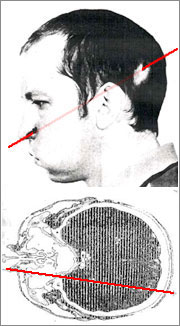
So it was in 1978 that when the proton beam entered Anatoli Bugorski's skull it measured about 200,000 rads, and when it exited, having collided with the inside of his head, it weighed in at about 300,000 rads. Bugorski, a 36-year-old researcher at the Institute for High Energy Physics in Protvino, was checking a piece of accelerator equipment that had malfunctioned - as had, apparently, the several safety mechanisms. Leaning over the piece of equipment, Bugorski stuck his head in the space through which the beam passes on its way from one part of the accelerator tube to the next and saw a flash brighter than a thousand suns. He felt no pain.

From what we know about radiation, about 500 to 600 rads is enough to kill a person (though we don't know of anyone else who has been exposed to radiation in the form of a proton beam moving at about the speed of sound). The left side of his face swollen beyond recognition, Bugorski was taken to a clinic in Moscow so that doctors could observe his death over the following two to three weeks.

Over the next few days, skin on the back of his head and on his face just next to his left nostril peeled away to reveal the path the beam had burned through the skin, the skull, and the brain tissue. The inside of his head continued to burn away: all the nerves on the left were gone in two years, paralyzing that side of his face. Still, not only did Bugorski not die, but he remained a normally functioning human being, capable even of continuing in science. For the first dozen years, the only real evidence that something had gone neurologically awry were occasional petit mal seizures; over the last few years Bugorski has also had six grand mals. The dividing line of his life goes down the middle of his face: the right side has aged, while the left froze 19 years ago. When he concentrates, he wrinkles only half his forehead.


Here's a handy New York Times interactive feature on exactly what the LHC does and what it's looking for.

For citizens against the LHC, take action here! Run By Walter L. Wagner, a biologist-turned-physicist who protested the Relativistic Heavy Ion Collider in New York when it went online back around the turn of the century.

Possible doomsday scenarios created by the LHC (which Wagner also thought would have been the outcome of the RHIC's experiements) as outlined by the folks at Neatorama:

Micro black hole: Basically it's a region in space where gravity is so powerful that nothing, not even light, can escape. Planet-eating black holes are created when massive stars collapse on itself (and by massive, we mean massive - even our Sun isn't big enough to create a black hole if it collapsed. You'd need 10 times the mass of the Sun.)

There is a remote possibility that micro black holes can be created in the collisions at the LHC. These black holes are small: about 10-35 m across (the so-called Planck Length) and puny in mass (less than a speck of dust). These black holes would evaporate in 10-42 seconds in a blast of Hawking radiation. Even black holes with the mass of Mt. Everest would have a radius of about 10-15 m across. It would have trouble "eating" a proton, much less the entire planet. (Source: Pickover, C. (1997) Black Holes: A Traveler's Guide)

Strangelets: These are strange matters that, like the Ice-nine in Vonnegut's novel Cat's Cradle, would turn all matters it touched into strange matters and eventually all of the planet will be transmuted into strangelets.

The problem with strangelet doomsday scenario, besides being very bizarre, is that no one has ever seen a strangelet. It remains a hypothetical particle. Previous particle accelerators that operated at lower energy than the LHC were actually better candidates to producing strangelets, and so far, we're still here.

Magnetic monopoles: These are hypothetical particles with a single magnetic charge (hence the name) - either a north pole or a south pole, but not both. Magnetic monopoles "eat proton."

Actually, physicists have been looking for magnetic monopoles for a long time - and so far they've never found it. By calculations, magnetic monopoles are actually too heavy to be produced at the LHC.

Vacuum bubble: It is actually a very interesting idea in quantum field theory. It states that life, the universe and everything aren't the most stable configuration possible. Perturbations caused by the LHC could tip it into the more stable state (called the vacuum bubble) and all of us "pop" out of existence.


On an unrelated SkyNet-watch note, "[s]cientists have created the first 'humanoid' robot that can mimic the facial expressions and lip movements of a human being" just by watching its subject. HH! Start saving for that M4 SOPMOD now, though jump at the chance to pick up an M-14 with the ol' 7.62mm rounds -- the increased stopping power should prove useful.


Read more...

11 December 2008

Rising food prices are upping the cost of sheep for slaughter during the Eid season in Jordan. From the Jordan Times:

Concluding the pilgrimage and commemorating Abraham's willingness to obey God by sacrificing his son, the purchase and slaughtering of sheep and other livestock is a vital aspect to the holiday feast, the most important in the Muslim calendar.

But in light of rising fodder prices in addition to increased prices of other basic commodities, traders said citizens have been more hesitant to make purchases.

With the youngest and lightest Jordanian-raised lamb, around 25kg, being sold for JD90, nearly the price of a full 60kg sheep a year ago, traders and customers alike expect to have a lighter than normal holiday.
I wrote about this over the summer. I've provided a link to that post for your convenience.

With fuel prices on the way down, why are basic commodity prices still on the way up? Will investigate and report back soon.

Read more...

03 December 2008

Read more...
The views expressed on this blog are solely those of the author and do not necessarily reflect the opinions or positions of any organizations or institutions with which he is otherwise affiliated

  © Blogger templates The Professional Template by Ourblogtemplates.com 2008

Back to TOP