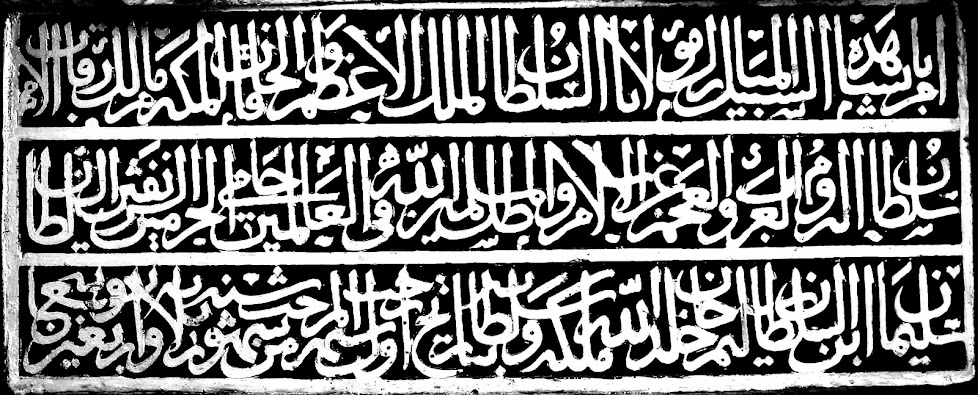
From the Kufiyeh Project (from which I bought a scarf over the summer): !صنع في فلسطين
28 November 2009

19 November 2009
Sarah Palin talks foreign policy:I believe that the Jewish settlements should be allowed to be expanded upon, because that population of Israel is, is going to grow. More and more Jewish people will be flocking to Israel in the days and weeks and months ahead. And I don't think that the Obama administration has any right to tell Israel that the Jewish settlements cannot expand.
26 October 2009
Noor in the Economist
Except this was news last summer. Since when is criticism of Israel the same thing as "anti-Jewish propaganda" and "Jew-bashing"? Sure, maybe the TV show and film employ antisemitic devices, but this article has highlighted not a one.
Read more...25 September 2009

Zahi Khouri writing in Foreign Policy:
The idea of "economic peace" suggests an economic conflict, and the Palestinian-Israeli conflict is certainly not that. Although economic issues do figure into Palestinian concerns, they are not nearly as important as addressing the rights of Palestinian refugees, terminating Israel's occupation of Palestinian land, and establishing a viable, independent, and sovereign Palestinian state, with East Jerusalem as its capital. To suggest that economics are what this is about would be to sideline history and to willfully ignore the reality of Israel's occupation. This conflict is political and it calls for a solution that is political.Read more...
15 September 2009
01 September 2009

29 July 2009
Yesterday, Al Jazeera English aired an extended version of the Made in Palestine documentary, including expanded segments about the effects of Chinese manufacturers and an added segment about Israeli kufiyehs.
Part 1
Part 2
19 July 2009
صنع في فلسطين
Last week I was able to buy an authentic Palestinian kufiyeh made in the Hirbawi factory, the last remaining mill of its kind in the West Bank. The Jerusalem Fund / Palestine Center has them for sale for those in the DC area.
Made in Palestine, Hebron
Original Hirbawi Shamagh (kufiyeh)
In January, French journalist Benoit Faiveley visited Hebron (al-Khalil, الخليل) and interviewed Mr. Hirbawi, subsequently made into a short documentary about the factory, Keffiyeh - Made in Palestine. Also featured in the film is Mohammed As-Saafin, a student from Ramallah who is interning at the Palestine Center this summer and, ironically enough, sold me my kufiyeh.
If you can't get your hands on one directly, Hirbawi kufiyehs are available to order from The Kufiyeh Project.  Organized in April by a group of activists concerned with the decline of the Palestinian kufiyeh industry, the Project imports and distributes the kufiyehs in order "to proactively promote the kufiyeh as a symbol of Palestinian identity, resistance, struggle for justice, and solidarity... [and to] support Palestinian industry and make sure that kufiyehs continue to be produced in Palestine." As the documentary and Kufiyeh Project website explains,
Even while the kufiyeh enjoys a surge of popularity around the globe, the family-run company that produces this symbol of the Palestinian national struggle has been slowly grinding to a halt. "It's the Chinese imports," explains Yasser Hirbawi, the 76 year-old factory owner. "In the 70’s we could barely keep up with demand, but by the mid-90’s cheap Chinese scarves started coming in, because of globalisation and Gatt. We were forced to lower our prices and today we are working to a fraction of our capacity because we cannot compete." The factory used to produce more than 1,000 scarves a day, but now makes less than 100 - and struggles to sell those.Al Jazeera English and the AFP file similar stories from Hebron.
I was first alerted to the kufiyeh kraze by Dr. Ted Swedenburg, whose blog is the authoritative one-stop shop for all things jihad-chic. I bought my first kufiyeh in the spring of 2007, around the time of the media and consumer craze for the thing, from a second-hand shop in San Francisco. As it turned out, that make was of the Urban Outfitters' "Anti-War Scarf" controversy. Urban was pressured into dropping the product from its spring line, which had caused a ruckus amongst fundies and their ilk who still can't seem to get over it (and continue to prove their intellectual vapidity.) But UO only did so with the black and red varieties (a little too jihad-chic?), which were then passed on to the vintage and thrift stores around town. Read more...
18 July 2009
The phenomenon lives! Noor coming to a box office near you!
MBC, the Arab world's leading free-to-air TV net, is preparing to make a film out of Turkish sudser "Nour," which became a pop-culture phenomenon when it aired across the Arab world last year.Read more...Project will reunite Turkish thesps Kivanc Tatlitug and Songul Oden, who captured the hearts of Arab auds in their husband-and-wife roles of Muhannad and Nour, respectively.
16 July 2009
More on the PA's closing of the West Bank Al Jazeera office. From Marc Lynch:
The PA decision is more troubling than the run of the mill story of Arab regimes hating free media, though, because it comes at a time when the contours of an emerging Palestinian state are being shaped. Salam al-Fayyad's role in the crackdown is particularly disturbing, given the great hopes which the U.S. has placed on him personally. The reflexive hostility to a free media shows yet again why the Palestinian Authority in its current configuration is a poor foundation for building a viable Palestinian state and the need for major political and institutional reforms. What does it say for the hope of building a political system on the basis of the rule of law and political freedoms when its U.S.-backed leadership cavalierly closes down media outlets it doesn't like?And from Brian Whitaker writing in the Guardian:
The Palestinian information ministry adopted the usual line yesterday when it said the ban on al-Jazeera was intended to protect "Palestinian interests", ie those of the Fatah establishment.Read more...In the days when there was only print and terrestrial TV, this idea that the media should be harnessed in the service of "the nation" (as defined by those in power) was fairly easy to maintain. "Licensing" of non-government newspapers and the general culture of deference kept a lid on things within the country, while "undesirable" material from outside could be stopped at the borders.
That began to break down with the arrival of new media that recognised no national boundaries: first satellite television – al-Jazeera, the most popular Arabic channel, started up in 1996 – and then the internet. Old attitudes persist, though. In Jordan, for instance, the main front-page "news" every single day is what the king did yesterday.
Uyghurs address the Arab World
Last week Al Jazeera hosted several Uyghur-American activists to discuss the recent ethnic violence in Eastern Turkestan / the Xinjiang province. Both Alim Seytoff and Nury Turkel of the Uyghur American Association and the World Uyghur Congress (WUC) stopped by the studio to counter the official Chinese line (swallowed by certain American politicians in a War on Terror-fervor) that all Uyghurs are essentially violent, separatist terrorists aimed at establishing an Islamic state in Eastern Turkestan.
Mr. Turkel told me off-camera that there are three main reasons behind Beijing's repression: an international geopolitical border with eight countries; natural gas reserves in the province that rival those in Kuwait (not to mention strategic pipelines and access to the Caspian: "Xinjiang unrest: The oil and gas connection," Financial Times); and the Uyghur's assertion of their identity seen as interference in state-directed national assimilation, economic growth, and social cohesion ("The Uighurs’ revolt undermines China’s idea that its people will always happily trade freedom for prosperity," The Economist). As he says elsewhere, "Uyghurs are the Tibetans you haven't heard about" (why not?). A Muslim Turkic minority,  Uyghurs have found almost no support from Muslim-majority countries other than Turkey. Mr. Turkel believes that one phone call from Riyadh would end the whole thing. Instead, Uyghur mosques, religious leaders, and even Qur'ans are controlled by the Chinese government in efforts to manipulate and undermine this symbol of ethno-religious other-ness (see this page at the Uyghur Human Rights Project). Women, anyone under the age of 18, state employees, workers and retirees, and communist party members are barred from entering the mosques, as this picture (provided by Mr. Turkel) of a sign outside a Xinjiang province mosque reads.
 On Thursday, Rebiya Kadeer, president of the WUC and essentially the Dalai Lama of the Uyghurs, was interviewed via live shot from Washington during the main newshour on Al Jazeera. The complicated translation process of Arabic-English-Uyghur and back posed a technical nightmare. We almost missed the shot -- if you watched it, Doha wasn't able to take her in Washington until the end of the program rather than at the top, as was scheduled -- and simultaneous translation (ducking out the source audio, in this case, Uyghur, and hearing Arabic instead) was just impossible. What this did mean was that she spoke uninterrupted, in her own tounge, allowing the forcefulness of her delivery to speak louder than the actual content. Mr. Seytoff interpretted, and thanked us kindly for allowing Ms. Kadeer the platform of addressing an audience largely unaware of the Uyghur cause.
And, of course, the intern got a photo out of the deal.
15 July 2009
The PA does not heart Al J
And in perfect poetic timing as a counterbalance to the last post, this story from the BBC: "Al-Jazeera closed in West Bank" (see reports also from the Guardian, AFP, and AP).
The self-rule body said al-Jazeera promoted a negative view of its work and that the coverage is biased.And from Bloomberg:
It comes a day after a guest on the station accused Palestinian leader Mahmoud Abbas of collaborating with Israel to have Yasser Arafat killed.
The channel - based in Doha - said it was "stunned" by the Palestinian Authority's decision. But the BBC's Arab Affairs Analyst, Magdi Abdlehadi, says the controversy surrounding al-Jazeera's broadcast reveals more about the crisis within Mr Abbas's group than about the satellite channel's often rocky relationship with Arab states.
The action was taken today because of a story the Qatar- based broadcaster aired that the authority considered false, it said in an e-mailed statement.
“Al-Jazeera is suspended since it dedicates a wide portion of its coverage to incitement against the Palestinian Authority and the Palestine Liberation Organization,” the Palestinian administration said, calling the action temporary.
The shutdown followed an interview Al-Jazeera conducted with Farouk al-Qaddumi, in which the longtime PLO official accused Palestinian Authority President Mahmoud Abbas [and, I should note, Mahmoud Dahlan] of collaborating with Israel to kill Yasser Arafat, who died in a French hospital in 2004.
And lastly, commentary from AbuKhalil:
Will the Committee to Protect Some Journalists issue a condemnation of the Abu Mazen-Dahlan gang for closing down AlJazeera offices in the West Bank? I very much doubt that and doubt that this important development will get any Western coverage. If the offices in Gaza were closed down by Hamas, the American TV networks would have interrupted their regular programming to broadcast the news. And the AlJazeera bureau chief in the West Bank is somebody with very moderate political views who is often criticized for being chatty with Israeli officials. But no one can deny his abilities and knowledge.Read more...
Israel does not heart Al J
"Tensions soar between Israeli UN delegation, Al-Jazeera," Haaretz.
The Arab network's chief UN correspondent, Khaled Dawoud, has accused the Israeli delegation of discriminatory policies and harassment. The Israeli diplomats, for their part, have accused Dawoud of disruptive behavior and of exploiting press conferences and events with Israeli officials as a podium to bash Israel.As'ad AbuKhalil finds Khaled a "fine journalist." While I haven't personally talked to the guy, I hear he presses pretty hard with his questions (that's the diplomatic version, right?), so much so that the French Foreign Minister once replied by insulting Dawoud's eyebrows. Read more...
29 June 2009
My own journey toward self-recognition started when I began to look more broadly at the struggles of indigenous populations throughout the world. I realized that Palestinians were not so "other" after all; there exists a substantial "we" of peoples alienated from our own lands across the glob. This recognition -- and the repudiation of an accepted status quo which attempts to legitimize our dispossession -- led me to activism. The Palestinian narrative had become much more than the story of my family's suffering. Palestine had become my cause.
As I continued to shape my views on social justice, I drew upon numerous accounts of oppression, including horrifying narratives of the Holocaust and Jewish suffering. Most of my education was in Catholic schools, where courses, from religion to history, acknowledged the pain endured by the Jewish people. The basic appeal of justice, I began to understand, transcends designations such as Arab and Christian and black. It is a fundamentally, irreducibly human appeal. I am convinced that my own activism is often fueled, not by an internal strength, but by the passion and efforts of so many Latino-American, Asian-American, and African-American communities as well as the solidarity shared with many across the religious spectrum.
Remi Kanazi
"Introduction," Poets for Palestine
A collection of images from the Boston Globe: Iran's presidential election, Iran's disputed election, continued election turmoil, and a troubled week for Iran.


23 June 2009
Chaos
Schemers...

...trying to control...


...their little worlds.

I'm not a schemer. I try to show the schemers how pathetic their attempts to control things really are.
I took your little plan...

...and I turned it on itself.

Introduce a little anarchy. Upset the established order, and everything becomes
c h a o s.

Oh, and you know the thing about chaos?

It's fair.
 Read more...
17 June 2009
LendforPeace.org
 Wanted to point you in the direction of a most awesome startup non-profit, LendforPeace.org. The organization, endorsed by the Clinton Global Initiative and coordinating with USAID, the UN, and the World Bank, offers microfinance loans to Palestinian entrepreneurs and small business people inhibited by the lack of access to capital and credit, markets which are virtually non-existent under the Israeli occupation. With a nod to the Road Map's "Land for Peace" formula, Lend for Peace's mission statement:
 While there are many contentious issues in this region of the world, we can all agree that there is no winner in poverty. By encouraging economic opportunity and hope through microfinance, LendforPeace.org seeks to foster stability and peace in the Middle East.
Best of all, anyone can lend; contributions, which start at $25, are donated to a specific Palestinian venture by way of short-term loans distributed by local partner organizations. And as a micro-loan operation, financiers are eventually repaid, usually in eighteen months or so. Craig Nemark (the craigslist Craig) recently hopped on board, and even Fox Business featured LFP in an April segment:
No matter what your politics or religious tendencies tell you about Palestinians or the Arab-Israeli conflict, this is a transparent and practical way to do something more than just offer sympathies to another oppressed people or only feel passionate about those living in poverty. As the esteemed Jimmy Doyle recently said, too often our awareness of global causes turns into another form of self-indulgent consumerism. I have talked to Palestinians who very much want average Americans to know their stories, to realize the daily hardships and humiliations of living under the heel of occupation. But staying informed hardly benefits the Palestinians, or anyone for that matter, in any real way.
While economic development is not the end-all be-all of the conflict, nor will it by itself alleviate Palestinian suffering, the fact of the matter is that Palestinians in the territories face intolerable and morally unacceptale living conditions due in part to the lack of economic oppurtunity under the occupation. I try not to get preachy, but if you care about the well being of those living in poverty or find the Palestinian plight particularly appalling, I strongly urge you to look into LendforPeace.org.
PS. Follow the FLP blog.
Subscribe to:
Posts (Atom)